
Red Lake County Court Records After a Jail Arrest
A Red Lake County arrest that requires jail custody normally routes through law enforcement, then booking at the Northwest Regional Corrections Center in Crookston. Red Lake County does not operate a separate jail building, so the custody side runs through Tri-County Community Corrections and NWRCC. If local criminal, traffic, petty misdemeanor, juvenile, or related charges are filed in Red Lake County, the court side moves to Red Lake County District Court in Red Lake Falls, part of Minnesota's Ninth Judicial District.
The jail roster and the court record answer different questions. The jail inmate records page is the better place to confirm current custody, the roster row, incarceration date, date of birth, and controlling charge shown by NWRCC. The jail mugshots page explains the booking photo column in the current roster PDF. Court records after an arrest focus on the prosecutor's filing, the case number, the charge list, hearing settings, warrants, bail conditions, judgments, and whether the case ended in conviction, dismissal, or another disposition.
The Red Lake County Attorney is Tanner Holten. The county attorney's office is the chief prosecutor for adult crimes and juvenile offenses in Red Lake County, so a complaint or other charging document may differ from the arrest charge or controlling charge visible on the regional jail roster. That distinction matters when a roster row says failure to appear, fugitive from justice, probation violation, parole violation, or a broad offense label. The filed court record is the source for the formal charge history.
How to Find Red Lake County Court Records After an Arrest
Minnesota Court Records Online, usually shortened to MCRO, is the public court-record portal for Minnesota trial court records. It has separate search tabs for Case Search, Document Search, Hearing Search, and Judgment Search. Users must accept the MCRO terms before searching. Red Lake County District Court and court administration remain the route for certified copies, local file questions, and pending cases that do not appear by name in the online portal.
The MCRO overview from Minnesota Judicial Branch explains the main public search tabs. That source is useful because Red Lake County District Court records are not held in a county-only case portal.
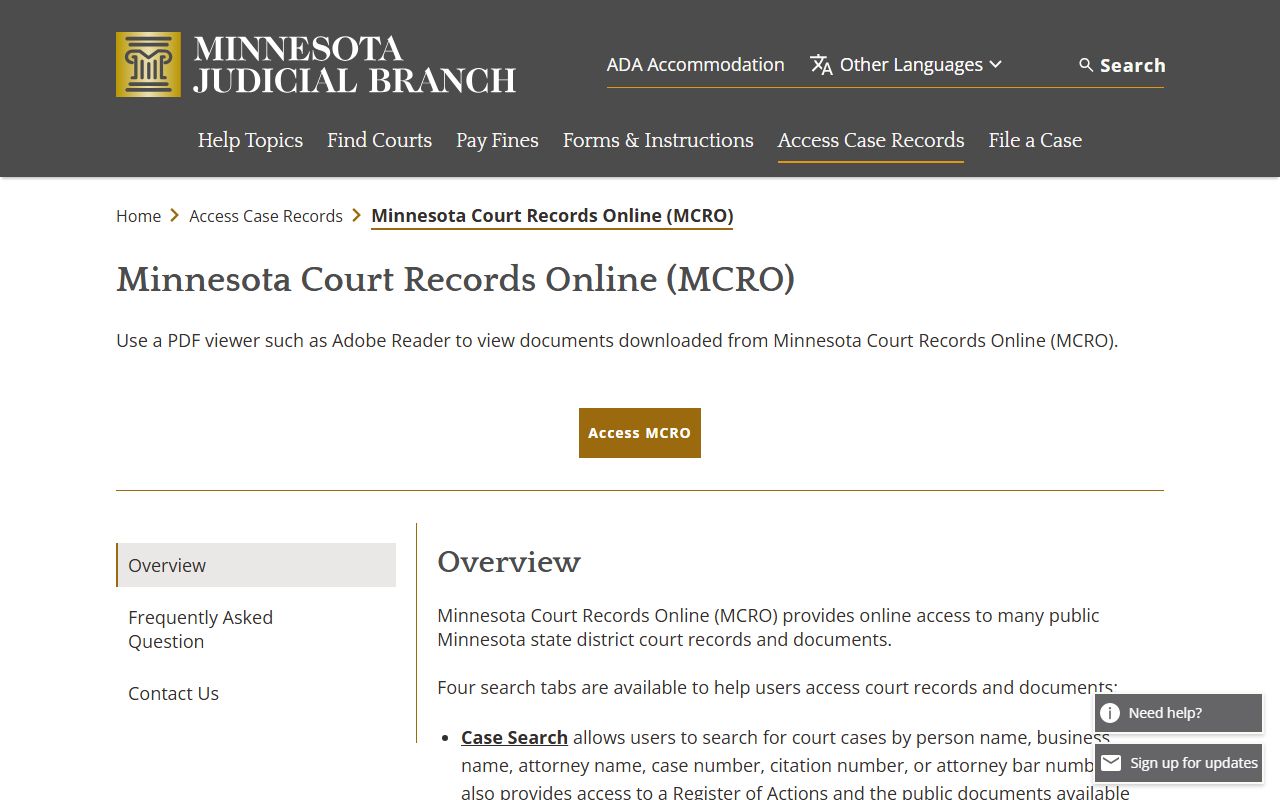
Use the MCRO tabs by the kind of information available. A case number usually gives the cleanest result. A citation number can help for traffic and petty misdemeanor matters. For pending criminal, traffic, and petty misdemeanor cases that have no conviction, a defendant-name search is limited by MCRO rules and may not return the case.
- Start with the NWRCC roster if the issue is current custody, then write down the person's name, date of birth, incarceration date, and controlling charge.
- Open MCRO and accept the terms. Use Case Search when you have a case number, citation number, party information, attorney name, or attorney bar number.
- Use Document Search if you already know the case number and need available public filings, such as a complaint, order, judgment, or hearing notice.
- Use Hearing Search for upcoming or past court dates, but confirm urgent timing with Red Lake County District Court because online data may lag or be incomplete.
- If the case is pending and no case or citation number is available, contact court administration instead of assuming no case exists.
MCRO name searching has important limits. The MCRO FAQ states that pending criminal, traffic, and petty misdemeanor cases without a conviction do not return in defendant-name searches. Dismissed cases and cases continued for dismissal are treated as pending for that name-search rule. For those cases, use a case number, citation number, attorney name, attorney bar number, or court administration.
| MCRO field or tab | Best use after a Red Lake County arrest | Limit to remember |
|---|---|---|
| Case Search | Find a case by case number, citation number, party, attorney, or attorney bar number. | Pending criminal name searches are restricted until conviction. |
| Document Search | Look for public filings tied to a known case number, including complaints and orders. | Not every document is public or available online. |
| Hearing Search | Check hearing settings after a case is filed. | For same-day or high-stakes timing, call court administration. |
| Judgment Search | Check judgment information when the case has reached a judgment stage. | It does not replace a certified court record. |
| Wildcard or Sounds Like | Broaden a name search when spelling varies. | Broader searches can return unrelated people and still will not bypass pending-case limits. |
How Charges Get Filed After an Arrest: Complaint, Information, and Indictment
After a Red Lake County arrest, booking at NWRCC can happen before the court file is easy to locate online. The charge record begins when a prosecutor files a charging document in the correct court. For most local cases, that prosecutor is the Red Lake County Attorney's Office. The filing may keep the same basic offense label shown on the jail roster, or it may use different counts, statute citations, charge levels, or factual allegations.
| Document | Who uses it | What it does | Why it matters |
|---|---|---|---|
| Complaint | Usually filed by the prosecutor based on law-enforcement reports. | States the alleged offense, supporting facts, statute citation, and charge level. | Often the key first document for Red Lake County criminal cases after booking. |
| Information | Filed by a prosecutor in appropriate cases. | Charges a defendant formally without using a grand-jury indictment. | Can replace or follow earlier charging steps depending on procedure. |
| Indictment | Returned through a grand jury. | Accuses a person of serious offenses after grand-jury review. | Less common for routine jail arrests, but important in severe felony matters. |
Do not treat the first visible charge label as the final charge history. The jail roster is built for custody management. The court record is built for adjudication. Once a complaint or other charging document exists, the case record becomes the better source for count numbers, charge descriptions, statute sections, alleged offense dates, court events, and final dispositions.
Charge Status and What It Means
Charge status can change several times between booking and final disposition. A controlling charge on the NWRCC roster may describe why the person is held, but it does not prove the current prosecution status. MCRO, court administration, and certified records are the places to confirm whether a charge is still pending, amended, dismissed, or resolved by plea or verdict.
| Status | What it means | How to read it after an arrest |
|---|---|---|
| Pending | The case or count is open and has not reached final disposition. | A pending case may not appear in MCRO by defendant-name search before conviction. |
| Amended or reduced | The prosecutor changed the count, statute, level, or allegation. | Compare the court charge to the jail roster label before drawing conclusions. |
| Dismissed | The court dismissed the count or case, or the prosecution no longer proceeds on it. | Dismissal is not the same as expungement or automatic removal from every record system. |
| Convicted | The defendant pleaded guilty or was found guilty. | Conviction data may later appear in BCA public criminal history if it meets public-data rules. |
| Continued for dismissal | The case is held open under conditions and may be dismissed if conditions are met. | MCRO treats these cases as pending for certain name-search restrictions. |
Bond and Release After an Arrest
For a person booked into NWRCC on a Red Lake County matter, bail and release instructions can involve both the regional jail and the appropriate court administration office. NWRCC's FAQ says bail should be posted at the appropriate Court Administration Office during regular business hours. After business hours, money may be deposited into the inmate's account, and if the inmate has a negative balance, the deposit must cover both the negative balance and the bail amount.
Minnesota Rule of Criminal Procedure 6 governs release and bail in criminal cases. Minnesota Statutes 629.53 addresses bail deposits and explains that cash bail is treated as defendant property and may be applied to fines, restitution, and related obligations under the statute and court rules. Minnesota Statutes 629.62 provides a route to apply to a judge for bail when district court is not in session in the county.
| Bond or release type | How it works | Local caution |
|---|---|---|
| Cash bail | The full cash amount is paid or deposited according to court and jail instructions. | Use the appropriate court during business hours when directed; after-hours handling may route through the inmate account. |
| Surety bond | A licensed bonding company posts bond under its own agreement with the defendant or family. | The court's bond order controls whether surety is allowed. |
| Personal recognizance | The person is released on a promise to appear and obey conditions. | Jail staff do not create or change court release conditions. |
| Conditional release | Release is allowed with conditions such as no contact, sobriety, travel, or reporting rules. | Violating conditions can lead to a warrant or return to custody. |
| Hold or detainer | Another case, agency, warrant, probation issue, parole issue, or immigration hold may block release. | Rows showing failure to appear, fugitive, parole violation, probation violation, or Hold - INS need extra confirmation before money is sent. |
Warrants That Lead to an Arrest
No official Red Lake County online active warrant list was located on the sheriff site. A warrant may still appear indirectly. The NWRCC roster can show terms such as failure to appear or fugitive from justice when a person is in custody on a warrant or hold. MCRO can show active warrant flags, but the MCRO FAQ cautions that an active warrant flag on party information may or may not pertain to the case being viewed. Users may need to check additional cases or contact court administration.
For local warrant routing, the Red Lake County Sheriff's Office can be reached at 218-253-2996. For warrants tied to a filed Red Lake County case, use Red Lake County District Court or court administration. For detention data created after booking, TCCC's Data Practices process is the public-records route. Minnesota does not provide one simple statewide official public warrant search that replaces county, court, and custody checks.
Charges vs. Convictions in Court Records After an Arrest
An arrest, a charge, and a conviction are separate events. An arrest means a person was taken into custody or cited based on legal authority. A charge means the prosecution has accused the person in court. A conviction means the case ended with a guilty plea, guilty verdict, or other conviction disposition. Treating those terms as interchangeable can misread a Red Lake County court record.
The Minnesota BCA Public Criminal History Search is free and conviction-focused. It does not show arrest data. It also does not show juvenile data, federal data, other-state data, or public convictions older than 15 years after sentence completion. The BCA source is useful for statewide conviction history, but it is not a jail roster, active warrant database, or full MCRO substitute.
The BCA public search page is a separate statewide conviction-history tool, not the place to confirm a new Red Lake County booking.
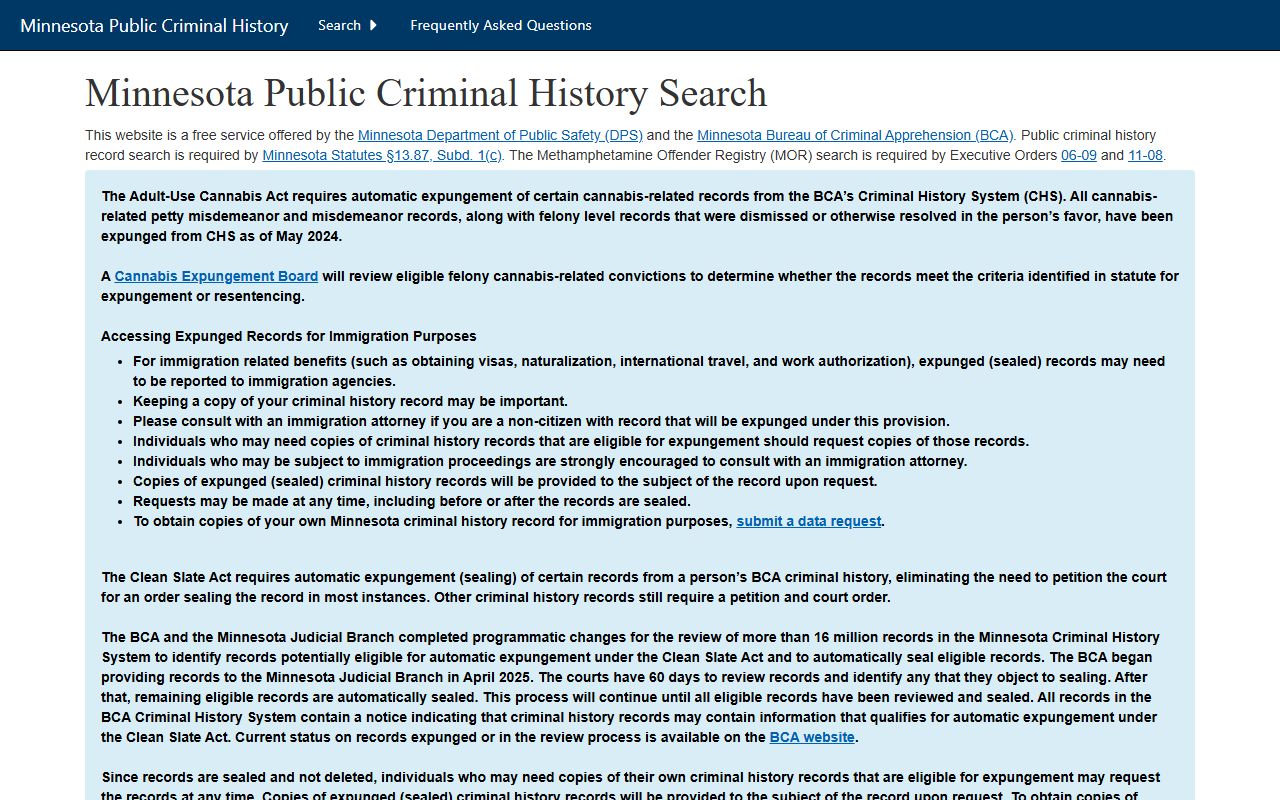
Use BCA history after understanding the court case status. A current jail arrest may be too new, may not have a conviction, or may remain pending in a way that keeps it out of defendant-name search results.
| Charge | Conviction | |
|---|---|---|
| Stage | An accusation filed in court. | A final guilty result by plea, verdict, or qualifying disposition. |
| Proof level | Based on charging standards and probable cause. | Requires proof beyond a reasonable doubt or a guilty plea. |
| Where to check | MCRO, charging document, and court administration. | MCRO judgment records, certified court records, and BCA public history when public. |
| Common mistake | Assuming a roster charge proves guilt. | Assuming every conviction appears forever in every public search. |
Sealed vs. Expunged Arrest Records
Minnesota public access rules protect some court, law-enforcement, corrections, juvenile, medical, and safety-sensitive data. Minnesota Statutes 13.03 is the general access provision in the Minnesota Government Data Practices Act. Minnesota Statutes 13.82 covers law-enforcement data. Minnesota Statutes 13.85 covers corrections and detention data created because of lawful confinement in jails, prisons, lockups, and similar facilities. Minnesota Statutes 609A is the state expungement chapter.
| Sealed | Expunged | |
|---|---|---|
| General effect | Public visibility is restricted by court order or access rule. | Access is limited under an expungement order and related law. |
| What changes | The record may no longer be visible to ordinary public users. | Court, law-enforcement, or agency records may be sealed from public view depending on the order. |
| What does not automatically change | Other agencies may still have records under their own authority. | Every copy, private database, or agency file is not necessarily erased at once. |
| Practical next step | Review the court order and ask the maintaining office how it applies. | Use the expungement order when making a data request or correction inquiry. |
For a Red Lake County case, sealing or expungement questions belong with the court record and the offices maintaining the data. If the issue also involves a booking photo or jail record, the TCCC data request process can be used after the court status changes, but the request should cite the exact case, person, date, and court order where one exists.
Background Check Considerations
Casual court-record lookup is not the same as an employment, tenant, credit, insurance, or other regulated background check. MCRO, BCA public history, NWRCC roster information, and data-practices responses all have boundaries. Pending charges, dismissed cases, sealed records, private corrections data, juvenile matters, and stale custody information can lead to a wrong conclusion if the user treats one source as complete.
Important: Red Lake County Inmate Population is not a consumer reporting agency, and its information may not be used for FCRA-covered decisions.
Restricted Court Records After an Arrest in Red Lake County
Some records after an arrest are public, some are partly public, and some are restricted. Juvenile matters, medical or psychological data, financial data, unrelated personal information, confidential law-enforcement information, and details that would endanger life or safety may be withheld or limited. MCRO is not the official certified court record, and online availability does not determine every public-record right.
For court copies, use MCRO where available, request copies by mail, or work with Red Lake County District Court administration. For detention records held by NWRCC or Tri-County Community Corrections, use the TCCC Data Practices process. For sheriff-created law-enforcement records before jail transfer, use the Red Lake County Sheriff's Office. For sentenced Minnesota prison custody, use the MNDOC public viewer at https://coms.doc.state.mn.us/publicviewer/. For custody notification, Minnesota VINE is available for county jail release notifications.